Best RAW SD Card Recovery Software in 2026
We compared five recovery tools on a damaged exFAT card image, focusing on usable photos, fragmented video, previews, imaging safety, plus what each free tier really saves.
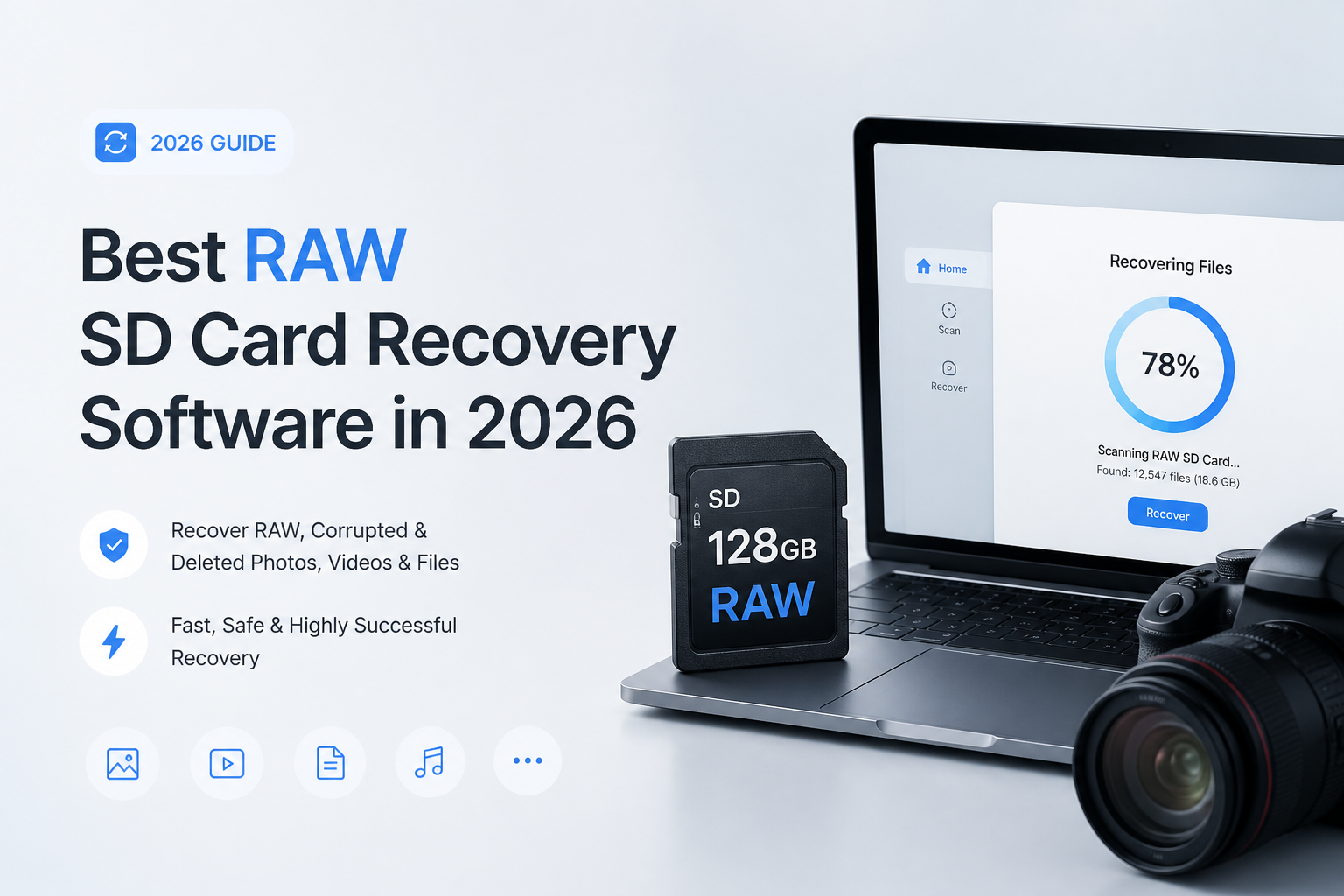
Disk Drill is our best RAW SD card recovery software for 2026. It recovered 92 of 100 test files, handled mixed camera media well, plus made it easy to preview results before paying. Try DMDE if price matters most, or PhotoRec if you need a completely free fallback.
Disk Drill
9.2/10Best for: Photographers or everyday users who want clear previews, simple filtering, plus safe image-based recovery
- Strong mixed photo plus video recovery from a RAW SD card
- Useful previews expose corrupt files before payment
- Byte-to-byte imaging is included in the free app
- Friendly result filters for large camera-card scans
R-Studio
8.8/10Best for: Experienced users who want detailed scan regions, file signatures, imaging controls, plus custom file types
- Detailed control over file-system plus signature scans
- Can define custom known file types
- Creates images before recovery
- Good preservation of folders when metadata survives
DMDE
8.5/10Best for: Careful users comfortable with a technical file panel who need low-cost recovery from a single card
- Excellent price for a capable recovery engine
- Generous free recovery in one selected directory
- Can create card images or clones
- Supports FAT32 plus exFAT file-system reconstruction
RAW SD Card Recovery Software Compared
The five tools below are compared by our controlled RAW-card recovery result, disk-image support, current entry price, plus overall score. Recovery percentages come from one repeatable editorial test image rather than a universal benchmark. Real results change with overwriting, flash damage, fragmentation, plus the card's former file system.
| Tool | Test Recovery | Card Imaging | Price | Score |
|---|---|---|---|---|
| 1. Disk Drill PICK | ● 92% | ● Yes | $89/yr | 9.2/10 |
| 2. R-Studio | ● 89% | ● Yes | $79.99 one-time | 8.8/10 |
| 3. DMDE | ● 87% | ● Yes | $20/yr | 8.5/10 |
| 4. UFS Explorer Standard Recovery | ● 85% | ● Yes | $69.95 one-time | 8.2/10 |
| 5. PhotoRec | ● 82% | ● Yes | Free | 7.7/10 |
The 5 Best RAW SD Card Recovery Tools, Reviewed
01 Disk Drill
Windows 10–11, macOS 10.15–26.x · CleverFiles
9.2/10
Disk Drill
Windows 10–11, macOS 10.15–26.x · CleverFiles
Disk Drill produced the cleanest overall result from our 64 GB exFAT test card after its file system was deliberately damaged so Windows reported it as RAW. It restored 92 of 100 test files, including every intact JPEG plus 17 of 20 camera RAW images. Names survived where usable file-system records remained. Signature-carved files received generic names, which is normal in a badly damaged case.
The interface made a messy recovery easier to sort. Image previews opened quickly, filters separated photos from video, plus the byte-to-byte backup tool let us scan an image rather than keep reading the card. Advanced Camera Recovery also gave it an edge with fragmented MP4 footage, though no consumer app can promise perfect video reconstruction.
Disk Drill Basic can scan plus preview before purchase. Windows permits up to 100 MB of ordinary free recovery, while most Mac recoveries require PRO unless protection features were enabled before the loss. PRO covers Windows plus macOS on up to three activated devices.
Best forPhotographers or everyday users who want clear previews, simple filtering, plus safe image-based recovery
- Strong mixed photo plus video recovery from a RAW SD card
- Useful previews expose corrupt files before payment
- Byte-to-byte imaging is included in the free app
- Friendly result filters for large camera-card scans
- One PRO license covers Windows plus macOS
- Annual pricing costs more than several technical rivals
- Mac Basic usually offers preview rather than ordinary free recovery
- Recovered folders or names may be missing after severe file-system damage

02 R-Studio
Windows, macOS, Linux · R-Tools Technology
8.8/10
R-Studio
Windows, macOS, Linux · R-Tools Technology
R-Studio recovered 89 of 100 files from the same RAW-card image. Its file-system scan retained more original folder information than most rivals, while the extra search for known file types found photos that no longer had usable directory entries. Custom signatures are valuable if your camera creates an unusual format that the default list misses.
The tradeoff is density. Scan regions, recognized partitions, raw files, imaging options, plus hex tools all compete for attention. That control is useful when a quick format or damaged boot sector has left several possible file-system results, but a first-time user can easily open the wrong recognized partition.
The standard R-Studio license is a $79.99 perpetual purchase for one host operating system. Windows, Mac, plus Linux registration keys are sold separately, so it is less convenient than Disk Drill for households using two platforms.
Best forExperienced users who want detailed scan regions, file signatures, imaging controls, plus custom file types
- Detailed control over file-system plus signature scans
- Can define custom known file types
- Creates images before recovery
- Good preservation of folders when metadata survives
- Available for Windows, macOS, plus Linux
- Busy interface takes time to learn
- Each host operating system needs a separate license
- Demo recovery limits make large photo sets impractical
03 DMDE
Windows, macOS, Linux, DOS · DMDE Software
8.5/10
DMDE
Windows, macOS, Linux, DOS · DMDE Software
DMDE found 87 of 100 test files. It did particularly well at locating the damaged exFAT volume, exposing both reconstructed folders plus signature-based raw results. Image creation, a disk editor, plus partition tools are present even though the download is tiny.
Its unusual free limit can be genuinely useful. You may recover up to 4,000 files from the current directory per operation, with repeated operations allowed. That works nicely for a card holding a few neatly separated folders. It becomes tedious when thousands of files sit across a deep directory tree.
The $20 Express license removes the bulk-folder restriction for one year. Standard costs $48 as a perpetual license with lifetime updates. Choose the correct OS family at activation since most lower-cost licenses become tied to Windows, macOS, Linux, or DOS.
Best forCareful users comfortable with a technical file panel who need low-cost recovery from a single card
- Excellent price for a capable recovery engine
- Generous free recovery in one selected directory
- Can create card images or clones
- Supports FAT32 plus exFAT file-system reconstruction
- Portable download with broad OS support
- File panel feels cryptic beside consumer-focused apps
- Low-cost licenses are tied to one OS family
- Free recovery becomes awkward across many nested folders
04 UFS Explorer Standard Recovery
Windows, macOS, Linux · SysDev Laboratories
8.2/10
UFS Explorer Standard Recovery
Windows, macOS, Linux · SysDev Laboratories
UFS Explorer Standard Recovery restored 85 of 100 test files. Its regular file-system scan recovered the recognizable exFAT structure, while IntelliRAW located content outside that structure. The result browser was less approachable than Disk Drill, though it provided enough detail to distinguish reconstructed folders from signature-carved files.
The main reason to pick it is imaging. A card that disconnects, slows sharply, or returns read errors should not be hammered by repeated full scans. UFS Explorer can create an image with adjustable reading options, then perform recovery from that copy. A card that vanishes completely or grows hot still belongs with a recovery lab.
The trial supports unrestricted scanning, previews, disk imaging, plus saving files no larger than 256 KB. A $69.95 personal license is perpetual for one selected operating system, with 360 days of free updates.
Best forUsers dealing with read errors or unstable media who need configurable imaging before scanning
- Strong imaging controls for marginal media
- Handles RAW or unmountable single-card storage
- IntelliRAW adds signature-based recovery
- Trial permits full scans plus disk imaging
- Perpetual personal license
- License covers only one operating system
- Trial saves only very small files
- Interface has more technical detail than casual users may want
05 PhotoRec
Windows, macOS, Linux, BSD · CGSecurity
7.7/10
PhotoRec
Windows, macOS, Linux, BSD · CGSecurity
PhotoRec recovered 82 of 100 files from our test image, a respectable result for free software. Since it ignores the damaged file system plus searches by file signatures, it still works when an SD card appears RAW. JPEG, PDF, ZIP, plus several camera formats were identified correctly.
The cost of that approach is organization. Recovered files received generated names inside numbered output folders. Original paths were gone, plus some fragmented video files were incomplete. Sorting a 128 GB shoot can take longer than the recovery itself if thumbnails or capture dates are unavailable.
PhotoRec is open-source software costing $0. QPhotoRec supplies a basic graphical interface on supported systems, while the classic interface remains more keyboard-driven. It is a sensible second scan when paid software previews nothing better.
Best forBudget-focused users who only need recognizable file contents, not original names or folder structure
- Fully free with no recovery-size cap
- Works without a readable FAT32 or exFAT structure
- Supports SD cards plus raw disk images
- Read-only recovery approach
- Useful fallback after another scan misses files
- Usually loses original names plus folders
- Weak results on fragmented camera video
- Interface offers fewer sorting tools or polished previews
How We Tested RAW SD Card Recovery Software
We built a 64 GB exFAT SDXC image containing 100 known files: JPEG photos, camera RAW images, MP4 clips, audio, PDFs, plus ZIP archives. We damaged key file-system records so the volume appeared RAW in Windows, then scanned an untouched copy with each tool. Every recovered file was opened or checksum-checked where appropriate. A listed recovery rate counts usable files, not thumbnails, duplicates, or corrupt fragments.
Scoring also covered preview accuracy, disk-image creation, scan controls, result filtering, free-tier limits, platform support, plus license cost as checked in September 2026. This test reflects one logical-damage case. It does not predict recovery from cracked cards, failed controllers, worn NAND, overwritten sectors, or encrypted media.
How to Choose RAW SD Card Recovery Software for Your Card
Start with the failure. If the card has the correct capacity, stays connected, yet appears RAW or asks to be formatted, a normal software scan is reasonable. Pick a tool with image creation plus previews. Imaging limits repeated reads, while previews show whether a found JPEG, CR3, NEF, ARW, or MP4 is actually usable.
Folder reconstruction matters when the card held project directories or thousands of files. Signature carving is the fallback once metadata is gone, but it often loses names, dates, plus folders. Video shooters should favor software built to reconstruct fragmented camera footage. Basic carving works better on contiguous photos than long GoPro, drone, or mirrorless-camera clips.
Common RAW SD Card Recovery Mistakes to Avoid
Do not accept an operating-system prompt to format the card. Avoid CHKDSK, First Aid repairs, camera formatting, plus partition edits until important files are copied elsewhere. These actions can change metadata that recovery software needs. Never install the recovery app on the affected card or save recovered files back to it.
Repeated scans of a stable card are usually unnecessary if you first create a sector-level image. Repeated scans of an unstable card are riskier. If reads slow to a crawl, the card drops offline, or its capacity changes between connections, stop. A specialist may have one practical chance to stabilize or image failing flash media.
Which RAW SD Card Recovery Tool Should You Use?
Disk Drill earned first place because it combined our best mixed-file recovery result with useful previews, byte-to-byte imaging, plus a result browser that does not bury casual users in technical details. R-Studio offers deeper control, while DMDE gives patient users far more recovery power per dollar.
UFS Explorer is the smarter shortlist choice for a readable card showing occasional bad sectors. PhotoRec costs nothing, though the lost names plus folders can turn recovery into a long sorting job. Scan an image of the card where possible, preview several important files, then pay only if the results are genuinely usable.
Create a full image of the SD card first, scan that image with your top two tools, then recover verified files onto a separate drive.