ContentDetector.AI Review
ContentDetector.AI is no longer the simple standalone checker many people remember. The current version is a Moxby browser Mod with cautious, approximate feedback plus a few awkward setup requirements.
ContentDetector.AI is now a free Moxby browser Mod rather than a normal web checker. It can point out repetitive or robotic passages, but its own documentation says the result does not establish authorship. Use Clever AI Detector instead for no-sign-up checks, sentence-level scores, clearer explanations, plus a 10,000-word allowance.
The largest concern is false confidence: ContentDetector.AI can flag human work while missing edited AI text, so its result should never support an academic, employment, or disciplinary accusation.
ContentDetector.AI at a Glance
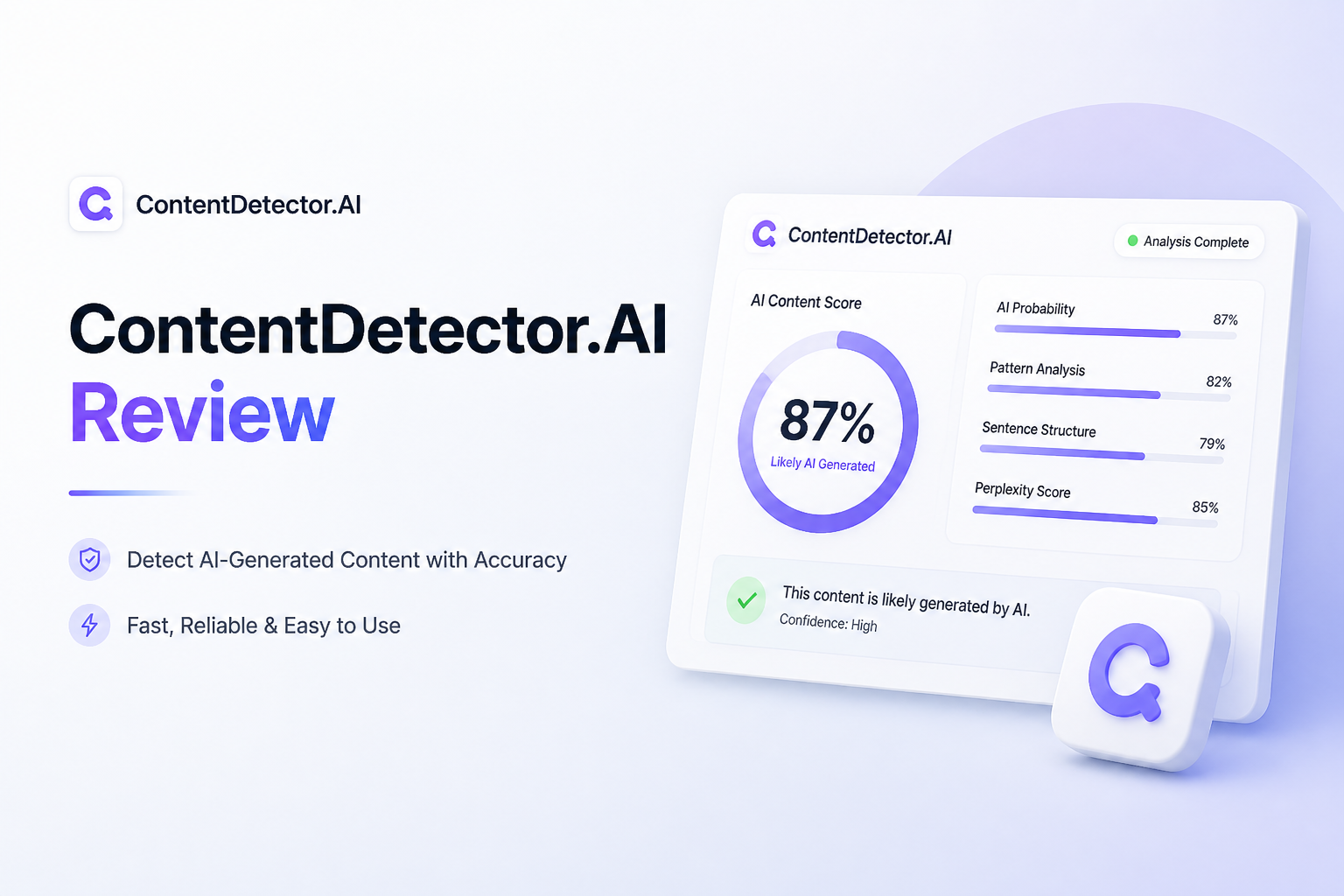
4.3/10ContentDetector.AI currently redirects to a Moxby Marketplace Mod. It reviews text for repetitive, uniform, formulaic, or robotic patterns rather than verifying whether AI wrote it.
Best forWriters already using the Moxby extension who want a light robotic-style check
- Approximate writing-pattern review
- Sentence-level passage highlights
- 10,000-character input limit
- Browser-based Moxby Mod
- Editing suggestions for flagged wording
- Free detector access
- Passage highlights
- Responsible limitations
- Extension required
- Small character limit
- Results remain approximate
ContentDetector.AI Scores Across Five Practical Criteria
| Category | Performance | Score |
|---|---|---|
| 01 Detection Guidance | 3.8/10 | |
| 02 Result Explanations | 5.2/10 | |
| 03 Ease of Access | 3.5/10 | |
| 04 Input Capacity | 5.8/10 | |
| 05 Cost and Value | 5.5/10 |
How We Evaluated ContentDetector.AI After Its Move to Moxby
We reviewed the live ContentDetector.AI domain on October 5, 2026, followed its redirect to the Moxby Marketplace, checked the current Mod description, compared published input limits, reviewed plan pricing, plus traced the stated data flow. Scores reflect access friction, usefulness of explanations, practical document capacity, cost, plus how responsibly the tool presents uncertain results.
We did not treat a detector's own marketing score as independent proof of accuracy. AI detection changes with text length, genre, editing, model, plus language, so the review weighs transparency plus workflow value more heavily than a single percentage.
When ContentDetector.AI Should Not Influence a Decision
Do not use ContentDetector.AI as the sole basis for accusing a student, rejecting a job applicant, penalizing an employee, or disputing a freelancer's invoice. Its current product page explicitly says human writing may be flagged while edited AI-assisted writing may pass.
A safer review combines version history, document metadata, cited sources, factual errors, sudden style changes, plus a direct conversation with the writer. Detector output can point toward a passage worth checking. It cannot establish intent or authorship.
ContentDetector.AI Detection Features, Limits, plus Access Problems
01 Detection Guidance
Approximate patterns, not authorship evidence
3.8/10
Detection Guidance
Approximate patterns, not authorship evidence
ContentDetector.AI no longer presents itself as a firm AI authorship checker. The current Moxby listing says it reviews robotic, repetitive, predictable, or formulaic writing patterns. That framing is responsible, yet it also exposes the central limitation: the output cannot tell you who or what wrote a passage.
Short copy, technical documentation, templates, plus heavily edited human work may trigger its strict thresholds. Edited AI material may look natural enough to slip through. The result works as a light editing hint, not a dependable detection decision.
- Avoids claiming absolute proof
- Can expose repetitive sentence structures
- Encourages manual review
- Does not determine authorship
- Human writing can receive a robotic signal
- Edited AI text may avoid flags
02 Result Explanations
Useful highlights with limited depth
5.2/10
Result Explanations
Useful highlights with limited depth
The Mod highlights passages that may need more specificity, variety, clarity, or voice. This is more helpful than a lone percentage because a writer gets a place to start editing.
The explanations remain broad, though. Labels such as predictable flow or generic language do not show which statistical signal caused a flag. Clever AI Detector goes further by scoring each sentence on a four-step scale, then listing possible reasons behind suspicious wording.
- Passage-level highlights
- Editing-focused wording
- Simple overall guidance
- Reasons can feel generic
- No detailed evidence view
- Limited transparency into scoring
03 Ease of Access
A browser extension stands between you and the tool
3.5/10
Ease of Access
A browser extension stands between you and the tool
Visiting ContentDetector.AI now redirects to a Moxby Marketplace page. You must install the Moxby extension before using the free Mod. That is a lot of friction for a task that normally takes one paste into a webpage.
The extension supports major Chromium browsers, Firefox, plus Safari according to Moxby. Still, users on managed school or work devices may lack permission to install it. Clever AI Detector runs in a regular browser page with no account, which is a cleaner fit for occasional checks.
- Free Mod is easy to locate
- Works within supported browsers
- No separate detector subscription
- Requires a Moxby extension
- Poor fit for locked-down devices
- Former standalone URL now redirects
04 Input Capacity
Reasonable for short drafts, cramped for long work
5.8/10
Input Capacity
Reasonable for short drafts, cramped for long work
The current Mod accepts up to 10,000 characters. That is enough for an email, cover letter, short article, or a section of an essay. Longer reports require several separate passes.
The character-based ceiling also creates an unfavorable comparison. Clever AI Detector permits up to 10,000 words per check, so full papers or substantial articles fit far more comfortably.
- Enough room for short articles
- Suitable for checking selected sections
- Clear published ceiling
- 10,000-character cap is restrictive
- Long documents need manual splitting
- No batch document workflow listed
05 Cost and Value
Free access with an unnecessary platform layer
5.5/10
Cost and Value
Free access with an unnecessary platform layer
The detector Mod works on Moxby's $0 Free plan. You do not need Plus merely to run this eligible Marketplace Mod. Moxby Plus costs $25 per month or $250 per year, though its extra chat, creation, plus automation tools are unrelated to basic detection.
Free is welcome, but price is not the only cost. Installing a broader browser platform for one detector adds setup, permissions, plus complexity. Clever AI Detector is also $0, carries no advertised paywall, needs no sign-up, plus allows unlimited checks.
- Detector available for $0
- No annual charge on Free
- Paid Moxby upgrade is optional
- Extension installation adds friction
- Paid platform features do not improve this basic use case
- Another browser service handles submitted text
ContentDetector.AI vs Clever AI Detector: Head-to-Head Results
We compared the current product pages, access requirements, input limits, result detail, stated limitations, plus published pricing. The comparison covers the tools available on October 5, 2026, not an archived version of ContentDetector.AI.
| Metric | ContentDetector.AI | Clever AI Detector |
|---|---|---|
| Access method | Moxby browser extension | Regular web page, no account |
| Per-check input limit | 10,000 characters | 10,000 words |
| Sentence-level review | Highlighted passages | Four-step sentence scoring |
| Flag explanations | General editing guidance | Possible reason for each AI-rated sentence |
| Model coverage | No detailed model list published | Lists ChatGPT, Claude, Gemini, Copilot, DeepSeek, Grok, plus others |
| Editorial caution | Strong warning against proof-based use | Uses probability language plus review warnings |
| Price for detector use | $0 with extension | $0 with no sign-up |
| Overall score | 4.3 / 10 | 8.8 / 10 |
Use Clever AI Detector Instead of ContentDetector.AI
Clever AI Detector removes the setup hassle while offering a much larger limit plus more useful sentence-by-sentence context.
01 Clever AI Detector
A clearer free checker without extension friction
8.8/10
Clever AI Detector
A clearer free checker without extension friction
Clever AI Detector handles the same basic job without forcing an extension install or account creation. You can paste up to 10,000 words, run unlimited checks, then inspect a document score plus a color-coded result for each sentence.
Its explanations are the practical difference. A flagged sentence may be tied to overly polished phrasing, weak personal voice, formal wording, missing specifics, or heavy transition use. No detector should be treated as proof, but this feedback gives editors more context for a manual review.
- No sign-up or browser extension
- 10,000 words per check
- Unlimited free checks
- Sentence-level probability signals
- Reasons attached to suspicious sentences
- Focused on English text
- Probability cannot prove authorship
- Newer tool with a limited long-term user record

What Users Have Reported About ContentDetector.AI
A freelance writer said fully human text received AI scores ranging from 86% to 100% across several detectors, including ContentDetector.AI. The experience raised concern about false accusations.
A commenter reported testing excerpts from their scholarly publications, then seeing those passages repeatedly flagged as suspicious by ContentDetector.AI.
One G2 reviewer liked the fast, simple interface but said nuanced writing could reduce detection accuracy. The reviewer also wanted batch checking for multiple documents.
Another G2 reviewer praised the free access plus simple layout, yet questioned reliability because accuracy was imperfect plus reporting was limited.
Why ContentDetector.AI Is Hard to Recommend in 2026
ContentDetector.AI may help existing Moxby users spot stiff or repetitive prose, but it is no longer a convenient standalone detector. The extension requirement, 10,000-character ceiling, plus approximate output make it a poor choice for teachers, editors, hiring teams, or students who need clear review context.
Skip it for consequential decisions. Use Clever AI Detector for quick screening, then verify every questionable passage through source history, drafts, citations, plus a human conversation.
Save draft history before running any detector, then treat each flag as a review cue rather than evidence of misconduct.