GPTZero Review
GPTZero produces polished reports, yet its verdicts become much less useful once AI text has been edited. The cost also feels hard to defend when Clever AI Detector offers longer checks for free.
GPTZero catches obvious, untouched AI writing, plus its sentence highlights are easy to inspect. Results on revised or mixed writing were far less convincing, so we would use the free Clever AI Detector for a more balanced first check.
The biggest risk is treating a probability score as proof, especially when a false flag could affect a grade, job, or reputation.
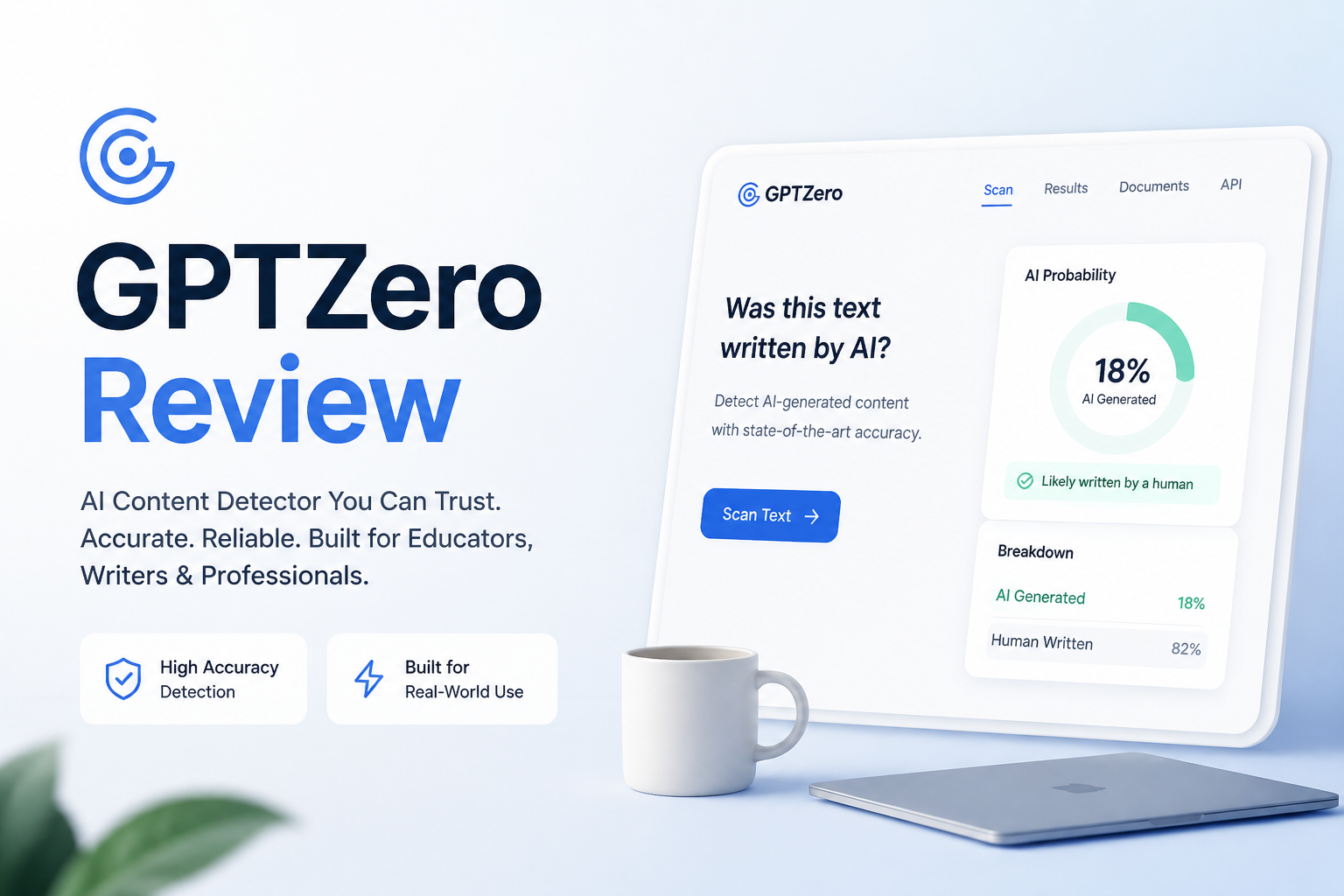
GPTZero at a Glance
5.8/10GPTZero is a web-based AI writing detector aimed at teachers, students, writers, recruiters, plus organizations. It estimates whether text resembles output from language models, then highlights suspicious passages.
Best forSchools already committed to a review policy that uses detector scores only as preliminary evidence
- Document-level AI probability
- Sentence-level highlighting
- Mixed human plus AI classification
- Writing replay plus plagiarism tools
- Batch, browser, LMS, plus API workflows
- Clear report layout
- Strong raw-AI detection
- Useful education integrations
- Weak on some edited-AI cases
- False flags remain possible
- Paid tiers lose value beside free alternatives
GPTZero Review Scores Across Five Practical Criteria
| Category | Performance | Score |
|---|---|---|
| 01 Detection Reliability | 4.8/10 | |
| 02 Report Explanations | 7.8/10 | |
| 03 Workflow Tools | 7.6/10 | |
| 04 Human-Text Caution | 4.5/10 | |
| 05 Plans Plus Free Access | 5.4/10 |
How We Tested GPTZero Across Human, AI, Plus Edited Writing
We compared the live product's reports, free limits, paid plans, support material, plus current detection model information. The review also considered published tests covering untouched AI, AI-edited drafts, humanized passages, mixed documents, plus verified human writing.
Detection reliability carried the most weight. Report clarity, workflow options, false-accusation risk, plus cost made up the rest. We reduced the score where results changed sharply after normal editing or where a precise-looking percentage needed substantial outside evidence.
When GPTZero Should Not Decide Who Wrote a Document
Avoid using GPTZero as the final judge in disciplinary, hiring, publishing, or grading decisions. A detector sees language patterns. It does not observe the writing process, identify the person at the keyboard, or know whether grammar software changed a draft.
For disputed work, inspect revision history, compare earlier samples, verify citations, plus ask the writer to explain key choices. If those records conflict with a detector score, the records deserve more weight.
GPTZero Detection, Reports, Workflow, Safety, Plus Pricing in Detail
01 Detection Reliability
Strong on raw output, shaky after revision
4.8/10
Detection Reliability
Strong on raw output, shaky after revision
GPTZero handled the easy case well. Long, untouched chatbot responses usually received a firm AI label, with suspicious sentences marked inside the document.
The trouble appeared after ordinary revision. In one published 2026 comparison using 600 AI-involved essays, GPTZero caught 43.7% overall. It flagged only 1.3% of essays where a student draft had been improved by AI, though its performance was much better on raw AI plus humanized output. That gap makes the headline score hard to trust without reading the sentence evidence.
- Usually catches long, untouched chatbot output
- Highlights individual passages for review
- Recognizes output from several major AI models
- Performance changes sharply by editing method
- One document score can hide missed AI sections
- Short passages provide weaker evidence
02 Report Explanations
The clearest part of the service
7.8/10
Report Explanations
The clearest part of the service
GPTZero does more than display a giant percentage. Sentence highlighting, document classifications, plus writing-pattern context give reviewers somewhere useful to start. The interface is easier to inspect than detectors that return only a red or green label.
Still, visual detail can create a false sense of precision. A highlighted sentence is a statistical signal, not a record of who typed it. The report works best as a reason to review drafts, citations, or document history, not as a finished misconduct finding.
- Sentence-level highlighting is easy to scan
- Mixed-content labels add useful context
- Reports look organized in longer documents
- Results are more informative than a bare percentage
- Precise percentages may look more certain than they are
- Explanations cannot establish authorship
03 Workflow Tools
Built for classrooms plus larger review queues
7.6/10
Workflow Tools
Built for classrooms plus larger review queues
GPTZero has a broader toolset than a simple paste-box detector. File uploads, batch review, browser tools, LMS options, writing replay, plagiarism features, plus an API make it more suitable for institutions.
Those extras are its best argument over Clever AI Detector. A teacher processing several classes may value centralized reports more than a casual writer does. For one-off checks, though, much of this machinery goes unused.
- Batch workflows suit repeated document checks
- Browser plus education integrations are available
- Writing replay can provide context beyond detection
- API access supports custom systems
- Useful workflow features sit beyond a basic checker
- The interface can feel busy for a quick second opinion
04 Human-Text Caution
False accusations remain the real concern
4.5/10
Human-Text Caution
False accusations remain the real concern
False positives matter more than missed chatbot copy when a real person may be accused. Researchers plus users have documented cases where GPTZero marked human writing as AI, particularly with formal, predictable, or highly polished prose.
Other evaluations have found low false-positive rates under controlled conditions, so GPTZero is not simply wrong every time. The practical issue is variation across genres, text lengths, plus thresholds. We would never act on one GPTZero result without version history or a direct conversation with the writer.
- GPTZero publishes guidance against using scores as sole proof
- Longer documents give the system more material
- Reports let reviewers inspect disputed passages
- Formal human prose can trigger suspicious labels
- Errors carry serious consequences in school or work
- Writers cannot easily disprove a statistical flag
05 Plans Plus Free Access
Costly beside a generous free rival
5.4/10
Plans Plus Free Access
Costly beside a generous free rival
The basic GPTZero checker costs $0, though limits apply to request size, document volume, plus advanced features. Annual individual pricing reviewed in September 2026 started at $8.33 per month, with higher tiers at $12.99 plus $24.99 per month.
That is difficult to recommend for occasional checks. Clever AI Detector currently accepts up to 10,000 words per scan with unlimited checks for $0. GPTZero makes more sense only if its classroom integrations, batch tools, or writing replay solve a specific workflow problem.
- A $0 basic checker is available
- Annual billing lowers the monthly rate
- Several tiers cover heavier document volume
- Paid value depends on trusting inconsistent detection
- Free access has tighter practical limits than Clever
- Overages may apply after plan allowances
GPTZero vs Clever AI Detector: Head-to-Head Results
We compared both browser-based detectors using the same kinds of raw AI, edited AI, human, plus mixed writing. Scores reflect practical detection, report usefulness, access limits, plus the amount of manual verification each result still required.
| Metric | GPTZero | Clever AI Detector |
|---|---|---|
| Untouched AI Drafts | Strong detection | Strong detection |
| AI-Edited Drafts | Major blind spot in the 2026 benchmark | 94.7% detected in the same benchmark |
| Humanized AI Text | 73.3% detected | 92.0% detected |
| Mixed-Text Review | Useful highlights, weaker mixed score in a matched test | Stronger mixed-section signal in the matched test |
| Per-Check Free Allowance | Up to 10,000 characters on the public checker | 80 to 10,000 words |
| Classroom Integrations | LMS, browser tools, API, batch workflows | Simple web checker plus file upload |
| Individual Price | $0 limited · Annual plans from $8.33/mo | $0 · Unlimited current web checks |
| Overall Score | 5.8 / 10 | 8.8 / 10 |
What to Use Instead of GPTZero
Choose Clever AI Detector if you want a free first-pass check with generous limits plus better performance on the edited-text cases that gave GPTZero trouble.
01 Clever AI Detector
A roomier free checker for practical second opinions
8.8/10
Clever AI Detector
A roomier free checker for practical second opinions
Clever AI Detector is our preferred alternative for writers, editors, students, plus teachers who need a quick screening result without buying a subscription. It accepts 80 to 10,000 words, provides an overall probability, shows confidence, plus marks sentence-level signals.
Its strongest advantage appeared on modified writing. In a 2026 benchmark, Clever detected 94.7% of AI-improved drafts plus 92.0% of humanized AI essays. The benchmark was published by Clever, so outside replication would strengthen those findings. Even with that caveat, free unlimited checks make it easier to recommend than GPTZero for routine use.
- Free unlimited web checks
- Up to 10,000 words per scan
- No account required for basic use
- Strong results on edited AI samples
- Sentence-level signals plus confidence cues
- English is the main supported language
- Saved history requires a free account
- No detector can prove authorship

What GPTZero Users Report About Accuracy
An educator who tested historical student essays said recurring false positives made single-detector reports unsuitable for accusations.
A student reported that an essay they wrote themselves received a 100% AI label, which led them to question the tool's current reliability.
One user found GPTZero inconsistent because paraphrased AI passed while some human writing received an AI warning.
A user who had tried several checkers said they liked GPTZero, though replies still urged caution with older human-written samples.
Should You Use GPTZero in 2026?
GPTZero has polished reports, useful integrations, plus solid detection of obvious chatbot output. We still do not recommend it for most individual users because revised text can expose large blind spots, while human prose can still receive damaging flags.
Schools that need LMS tools may find a role for it as one signal among several. Everyone else should start with Clever AI Detector, which offers longer free checks plus stronger results on edited AI in the available comparison data.
Save version history, drafts, citations, plus timestamps before scanning any important document, then treat every detector result as a review cue rather than proof.